
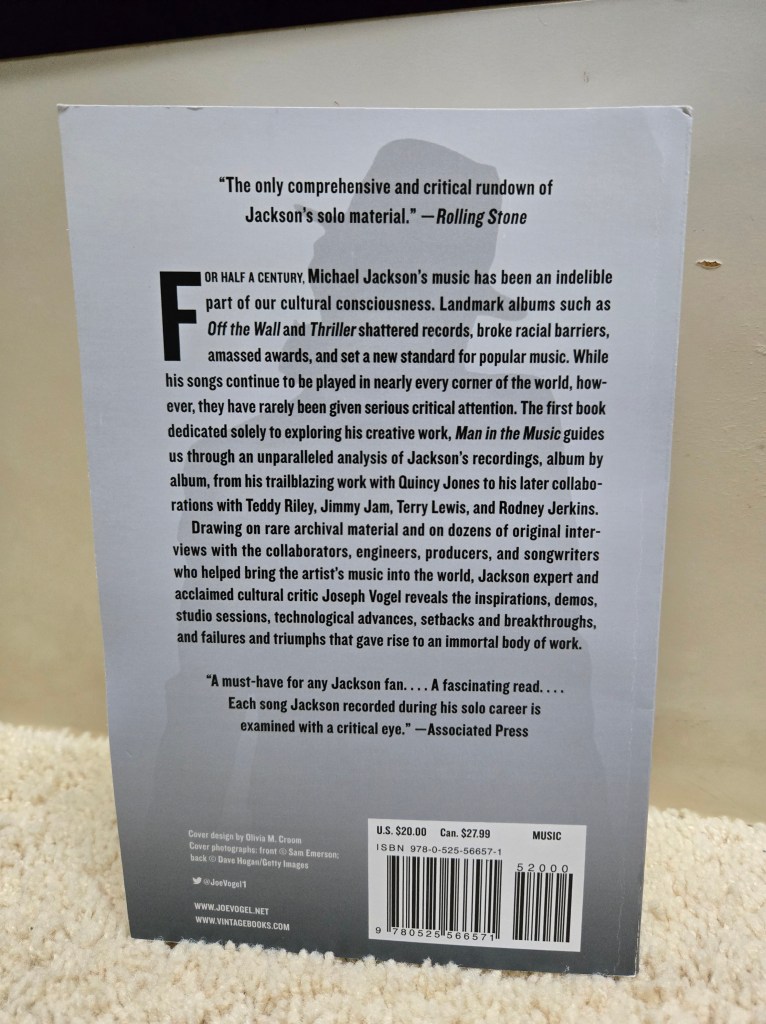
Man in the Music: The Creative Life and Work of Michael Jackson by Joseph Vogel is a well-crafted book about Michael’s creative process from the Off the Wall era to his final days when he was prepping for the This Is It shows. The first edition of the book came out in 2011 with a different cover, I believe, based on what I’ve seen online. I have the second edition that was released in 2019 with the front cover of Michael dressed in his white suit from the “Smooth Criminal” music video. According to Vogel, the second edition contains more behind-the-scenes details from the studio, he revises the mistakes he made in the first edition, separating the difference between fact and fiction; it strictly focuses on the music, and the posthumous albums are not included. While gathering research for the first edition, Vogel was lucky enough to speak with Michael’s collaborators such as Quincy Jones, Rod Temperton, Bruce Swedien, Greg Phillinganes, Steve Porcaro, Bryan Loren, Teddy Riley, Brad Buxer, Rodney Jerkins, and more. Many of them provided answers to Vogel’s follow-up questions for the second edition. In case you’re wondering, Buxer is the one Michael famously (and playfully) yells at (“Brad, what you gonna do?”) during a glitch on the Dangerous World Tour for the outro for “I Just Can’t Stop Loving You.”
Though Michael couldn’t read music or play instruments proficiently, he used his voice to convey the arrangements and melodies that popped into his head, including nearly every instrument. Assistant engineer Rob Hoffman recalls one morning Michael came in with a song he had written overnight. “We called in a guitar player, and Michael sang every note of every chord to him. ‘Here’s the first chord, first note, second note, third note. Here’s the second chord, first note, second note, third note,’ etc., etc.” Heck, he sang an entire string arrangement to save his butt! Considering how fearless and vast his music repertoire is, I wasn’t surprised to learn that Michael listened to artists far and wide such as Queen, Led Zeppelin, Grace Jones, Yellow Magic Orchestra, Hall & Oates, Pink Floyd, Tchaikovsky, Beethoven, and Nine Inch Nails. He was one of the few artists who could pull off singing rock one day and Broadway the next.
What I appreciate about Man in the Music is that it dives into the time period between albums, especially for the Bad era and onwards since there were four to six year-gaps between studio albums. Vogel talks about not only what was going on in Michael’s personal life, but also what was going on in the world overall. Between the Bad era and the Dangerous era, a lot changed in the music scene. The late ‘80s and early ‘90s marked the rise of the grunge movement and hip-hop was gaining traction in popular music; the latter was influencing genres like R&B, which merged together to create new jack swing. One of the more significant examples of this blend was Janet Jackson’s Rhythm Nation 1814, which was released in 1989. Vogel says that no album influenced Dangerous (1991) more than Rhythm Nation. Despite being the greatest entertainer of all time, Michael never stopped learning nor did he stop adapting to the changing times in the music industry.
Vogel’s book also talks about the dissolution of Jones and Michael’s partnership, and to be honest, I think both were right in their own ways. Michael had written dozens of songs for Thriller (1982), including his own version of “P.Y.T. (Pretty Young Thing),” but Jones was dead set on including songs from outside writers for more than half of the album. Both of them were control freaks, so it really came down to a power struggle between an artist who wanted to follow his own path and a producer who didn’t want to be left under the bus. Another thing that irritated Michael greatly was Jones’ reliance on Temperton, who wrote “Rock with You,” the title track, and “Burn This Disco Out” from Off the Wall (1979). To Jones’ credit, Temperton wrote “Baby Me Mine,” the title track, and “The Lady in My Life” for Thriller, which are total bangers. Heck, the title track became one of Michael’s biggest hits. Plus, I’m not a fan of Michael’s version of “P.Y.T. (Pretty Young Thing)” and I think “The Girl Is Mine,” which Michael wrote, is crap.
Michael actually didn’t want Jones to produce the Bad (1987) album, but his contract said he had to do three albums with Jones, therefore, there was nothing Michael could do about that. Still, that didn’t stop Michael from putting together his own group of musicians and engineers called the “B-Team,” a playful term poking fun at Jones’ A-Team, to help formulate what Michael initially wanted for the Bad album. The B-Team consisted of individuals such as John Barnes, Bill Bottrell, Chris Currell, and Matt Forger. According to Vogel, the B-Team was about freedom and independence. “Michael was maturing and coming into his own. So we were part of that team to help his maturation process. That’s what we were there to do,” says Barnes. Unfortunately, when Jones finally met up with Michael following prior obligations, he put an end to the B-Team immediately, viewing them as a threat. Jones, however, conceded to keeping Currell on board, whom he viewed only as an “operator.” It became painfully obvious to Michael, as the sessions went on, that Bad would be the last album he would do with Jones.
One of the things that surprised me the most while reading Man in the Music was “They Don’t Care About Us” and “Earth Song” were written during the Dangerous sessions, but weren’t perfected until the HIStory: Past, Present and Future, Book I (1995) album. “They Don’t Care About Us” was partially inspired by the Rodney King beating in 1991, but it took on a personalized meaning after the mistreatment Michael experienced from the Santa Barbara County Police Department regarding the 1993 allegations. “Earth Song,” initially called “Planet Earth,” was written when Michael was in Vienna on the Bad World Tour. Bottrell for sure thought it was going to be on the Dangerous album, but Michael held it back during the final weeks, believing the song wasn’t ready yet. Another song from HIStory that wasn’t written during the album sessions was the penultimate track, “Little Susie,” which was initially composed in 1979. “Little Susie” is a dark, twisted, horror-esque tale about a mysterious girl named Susie who tragically dies. It wouldn’t have worked for Off the Wall nor Thriller because he wasn’t musically out there yet, if that makes sense? By the time we got to the HIStory album, Michael was far more experimental with his music.
My biggest takeaway from reading Man in the Music, however, was that Michael wasn’t a genius; he was a human being. He had a heart, he had feelings, he liked to kid around from time to time, he made mistakes, and despite his best intentions, sometimes they bit him in the butt. In the mid ‘80s, stories of Michael undergoing a sex change, taking hormones to keep his voice high, building a shrine to Elizabeth Taylor, sleeping in a hyperbaric oxygen chamber, and buying the bones of Joseph Merrick were spreading like wildfire. Oddly enough, some of those stories were Michael’s ideas. In 1986, Michael told his managers, John Branca and Frank DiLeo, that he wanted “his whole career to be the greatest show on earth,” strategically keeping himself in the public eye and the people’s undivided attention. Unfortunately, with those stories, Michael buying the ATV music catalog, his constantly changing appearance, and the public fear of his growing power, his plan gave him more than what he bargained for. In 1995, when Michael did an hour-long primetime interview with Diane Sawyer on ABC, accompanied by Lisa Marie Presley, Michael told Sawyer before the interview that he was willing to answer ALL of her questions and considering all of her questions were about the controversies, that was not a smart move on Michael’s part.
I won’t dive into his addiction to plastic surgery nor his admiration for children because I feel like it would be rude to talk about those things. I will, however, briefly talk about his addiction to painkillers, which increasingly became a problem since the 1993 allegations. To deal with the stress, Michael was relying on Demerol, OxyContin, and morphine, which he was taking for his reconstructive scalp surgeries following the 1984 Pepsi incident. According to Vogel, Michael was taking propofol on the HIStory World Tour to deal with his insomnia. Additionally, he was treated for anxiety with benzodiazepines like Valium, Xanax, and Lorazepam. It can be argued that Invincible (2001) was the most sporadic and unfocused of Michael’s six solo albums because he was hardly involved in the songwriting process compared to Bad, Dangerous, and HIStory. Vogel also points out that when Invincible came out, Michael was in debt after years of excessive spending and poor business investments.
I’m not saying all of this to talk smack about Michael, though when I read the Diane Sawyer part, I did yell out loud, “YOU IDIOT!!!” I’m saying these things to remind myself that Michael wasn’t different from the rest of us and that made me sympathize with him more. Sometime after the 1993 allegations were made public, in a phone interview with journalist J. Randy Taraborrelli, when asked how he was doing, Michael says, “I’m just very, very…sad. It’s such a terrible world, isn’t it? No love in the world.” Out of all the celebrities I’ve read about, I believe Michael Jackson was the most scrutinized and dehumanized in the industry. That’s why I think it’s important for everyone to read about who he was as a person and see him not as the perfectionist he strived to be, but the music lover whose demons led him to make poor choices and walk down a dark path he never escaped from. I give Joseph Vogel’s Man in the Music book a rating of 5 out of 5 stars.
If you enjoyed this post, feel free to like it and share it with your friends. I write about music, Disney, movies, shows, and mental status. If that sounds like your cup of tea, please subscribe to my blog for more content like this! To help me keep this blog going, you can make a donation here. You can also follow me on social media through Facebook, Instagram, and X!
Don’t forget to leave a comment down below to start a conversation!
Take care and see ya real soon!
Lana


You have dived deep into Michael. Good for you. I just bought 5 of his CDs as I realized I didn’t have any on CD (only vinyl). The only book I have about him is the one called Michael Jackson Treasures. Pretty cool book and quite pricey. Got it in a collection I bought so I kept it. But it is tempting to sell as it would pay for the collection and then some that I got it from.
LikeLiked by 1 person
Thanks for your comment, John! I just looked up the Michael Jackson Treasures book on Amazon and dang, you were not kidding about it being pricey! Which CDs of his do you have? I didn’t know you liked MJ!
LikeLike
No matter how he ended up, his music was awesome. I have Off the Wall, Thriller, Dangerous, Xscape, This is It and Number Ones. I need the rest for sure
LikeLiked by 1 person
Oh yes, whether you like him or not, it’s impossible to deny the impact he had on the music industry and the artists that came after him. Oh, you have ‘Dangerous’ too? Nice, that’s one of my favorite! His post ‘Bad’ albums are so underrated. I’m surprised you don’t have ‘Bad’ yet, actually!
LikeLike