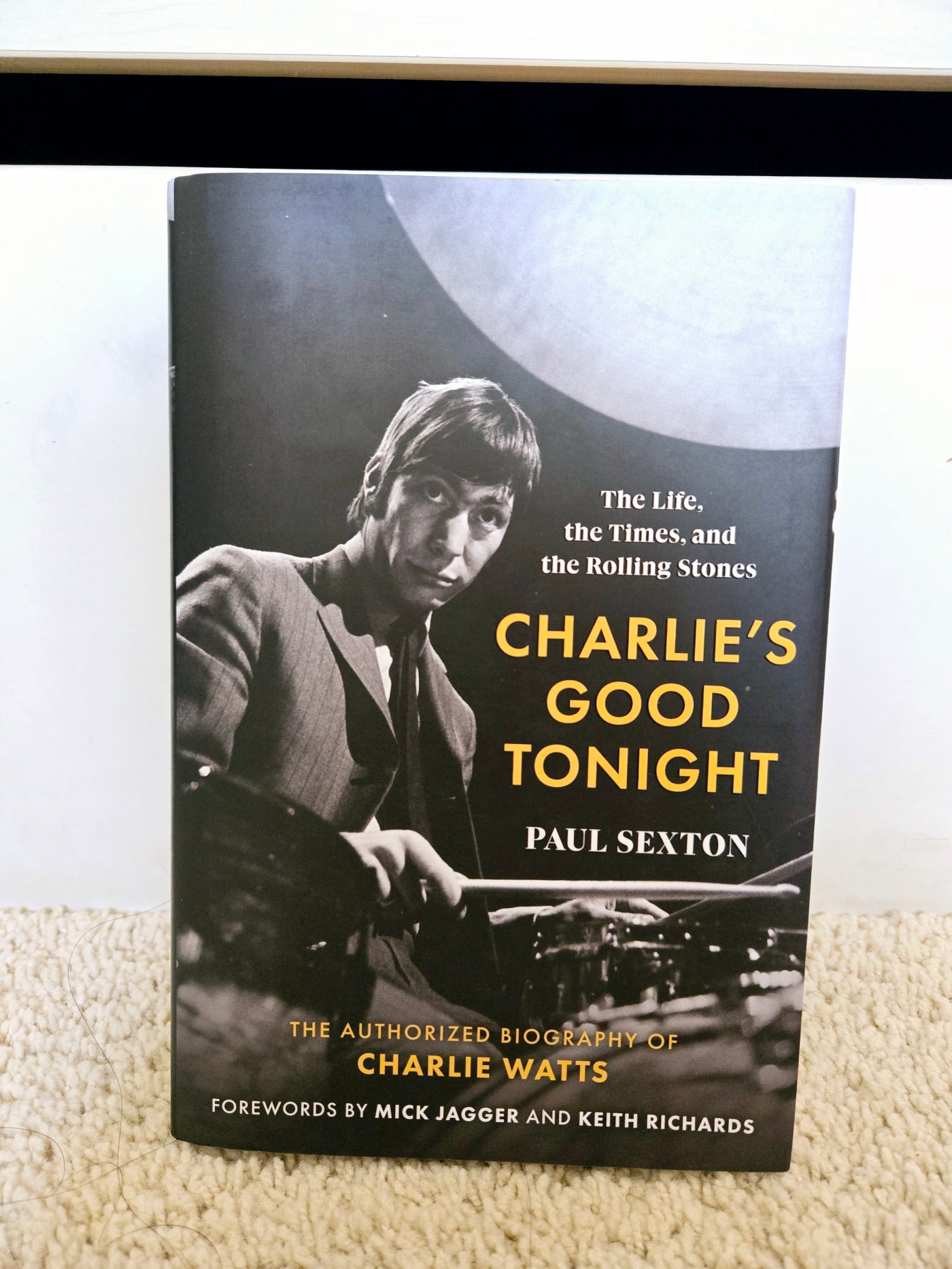
Charlie’s Good Tonight: The Life, the Times, and The Rolling Stones (2022) is the authorized biography of the late great Charlie Watts by Paul Sexton. Published one year after his death, the book details Watts’ life from beginning to end, and it features forewords by Mick Jagger and Keith Richards. No offense to the band themselves, but The Rolling Stones would not have been as successful if it weren’t for Watts. Being a jazz drummer, he made their music swing to the point where people wanted to get up and dance. Rock ‘n’ roll is supposed to be fun after all! The Rolling Stones with a different drummer would not have worked. Think of “Miss You” with Lars Ulrich behind the kit; that would’ve been a disaster!
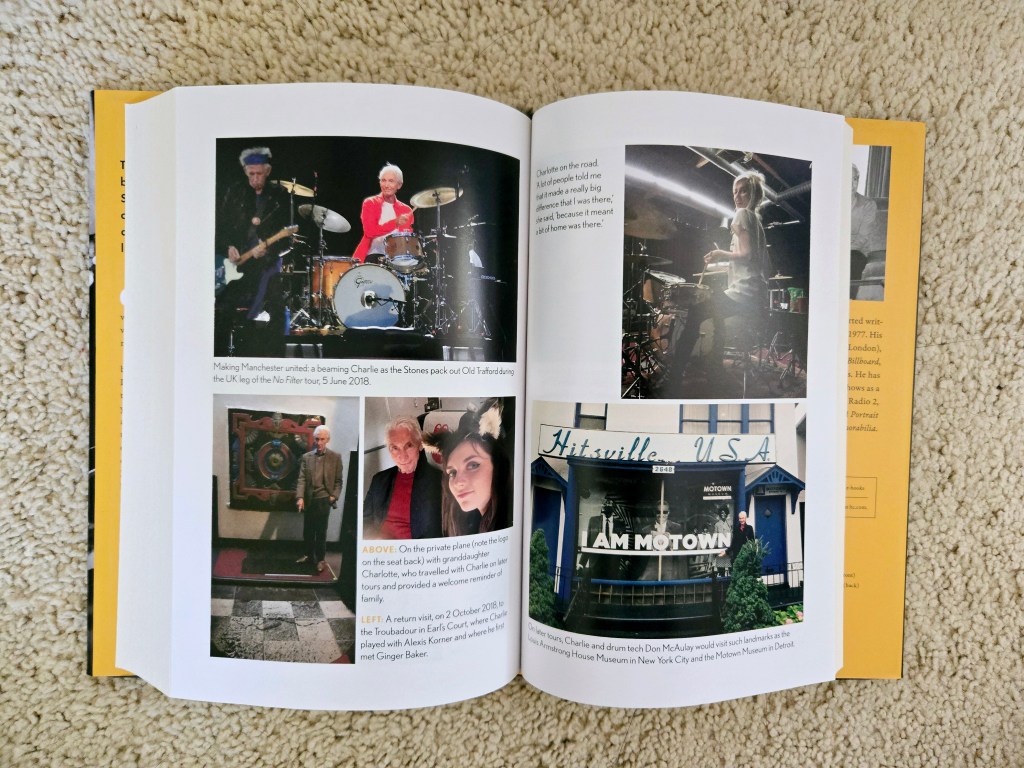
What I loved most about this book was discovering that fame did not change Watts at all. Throughout his whole life, he remained an introvert who preferred to stay indoors rather than go out to parties, favored dogs over human beings, spent a lot of money on tailored suits, didn’t know how to drive, despite owning a massive car collection, and didn’t like to listen to The Rolling Stones’ music (he was more of a jazz guy, as mentioned before). As cliché as it sounds, Watts was just a regular guy that played drums for a living. He hated being away from his family, so touring in the early years was a bit of a drag. It wasn’t until his granddaughter, Charlotte, began traveling with him that he started to enjoy the experience more because he had something to remind him of home. That was during the last few years of his touring life, when Charlotte was 17 years old.

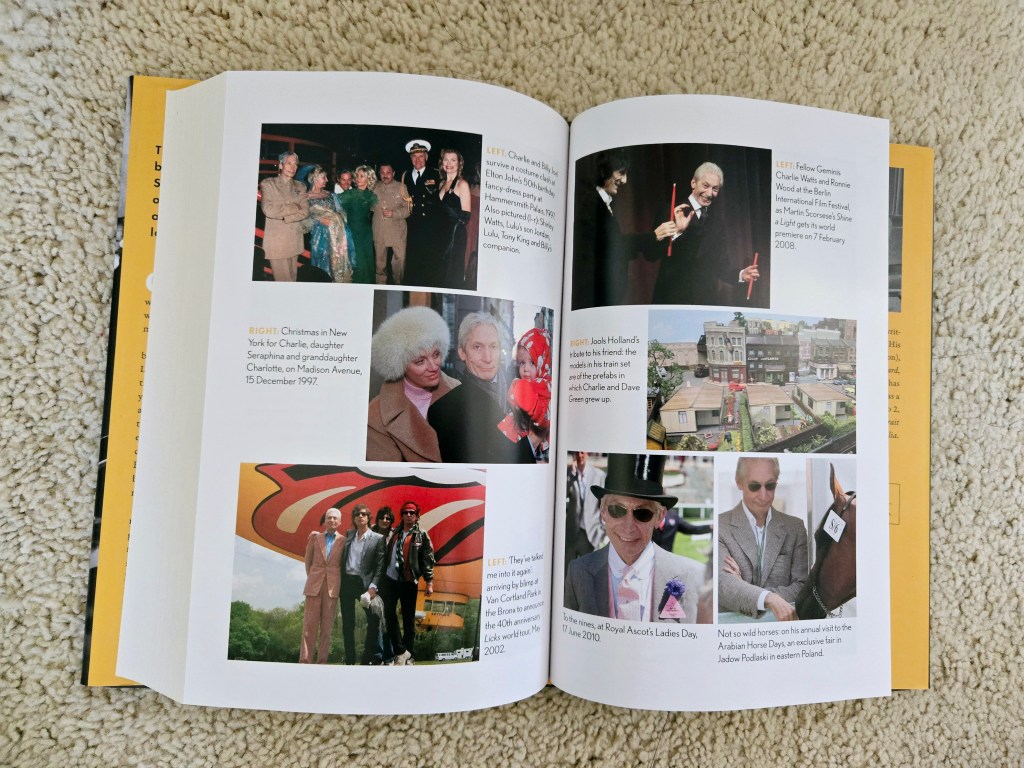
Watts is a reminder that rock ‘n’ roll doesn’t always have to be about sex and drugs. Back when there was negative stigma surrounding married pop stars, he married his wife, Shirley, in October 1964, without telling the band about it, even going as far as denying it to the press when they found out three weeks later. That’s how much he wanted to keep his life private. He had his own sense of humor that only those close to him really understood. Being into drawing and graphic design, he used to draw every bed he slept in while touring with the Stones because hooking up with groupies on the road was not his scene.
There was a brief period in the mid ‘80s, particularly during the Dirty Work (1986) era, where Watts was hooked on drugs and alcohol. His personality made a complete 180 degree shift, becoming a temperamental and violent person; that brief period almost cost him his family and career. There was this one time in New York, when Jagger was having a party with a bunch of celebrities in his hotel room and then all of a sudden, Watts showed up and Jagger made the mistake of calling the former “his drummer,” when introducing him to his friends. Watts was offended and punched Jagger, telling him, “I’m not your f*cking drummer, you’re my f*cking vocalist.” Thankfully, he found the willpower to give up drugs and alcohol for good, even going as far as becoming a vegetarian.
“I’m not that sensible,” he said. “But I never used to indulge in anything to excess until about [the age of] 45, so the male menopause, you might say, and I tried everything then. And I very nearly killed myself. I don’t mean overdosing or anything like that, I mean, I nearly killed myself spiritually, I nearly ruined my life,” said Watts.

Watts was not the type of person that favored attention from others, but he always made the effort to dress for success everywhere he went. There’s an adorable photo of him in the book, at the age of two, feeding pigeons with his parents, wearing a chic coat and a sophisticated beret on top. When he got into jazz music, not only did he admire the sound coming from the records, he also admired the wardrobe of artists such as Miles Davis, Charlie Parker, and Duke Ellington. Everything from his shoes, suitcases, t-shirts, suits, pants, and jackets were made with the right materials and designed specifically to match his needs. As he used to say, “he was the smartest-dressed man in jazz [not rock ‘n’ roll].” There were times, however, when his fashion sense took over his common sense, as noted by Charlotte in the book.
“He came to visit me at boarding school in upstate New York, and we’d have terrible snow, several feet, freezing. But, it was May, and it hadn’t snowed for weeks, so you’re thinking, it’s springtime. But, they had a freak blizzard over the weekend and he hadn’t packed for it. Sometimes, in London we’d get unexpected snow. I’d seen this twice – his absolute refusal to buy the right shoes for snow,” said Charlotte Watts.
“He came out with Tesco bags wrapped around his shoes. And we had to walk him up the hill for breakfast. Mortifying. He didn’t want to wear any other shoes for the weather. He so badly wanted to wear his own shoes that he was quite happy to go out with Tesco bags round them. We’d be in tears of laughter. I don’t know if he ever did it on tour, but he did it out in public in London, and when he was walking around the village in New York,” continued Charlotte Watts.
It’s also worth noting that Watts was very passionate about his instrument. He wanted to retire from The Rolling Stones so many times, but he never did because he would’ve been bored out of his mind; all he ever did was play drums. Whether it was paying tribute to Charlie Parker or working his magic on The Rolling Stones, Watts poured his heart and soul into his drumming. He wasn’t cocky or showboating his skills, he just did what he had to do. Producer and engineer Chris Kimsey recalled a story about “Some Girls,” which was initially a 15 minute jam session. Jagger asked him to shorten it to four minutes and that he could use any verses of his choice. Because of Watts’ precise timekeeping, Kimsey was able to put the end verses to the front of the song without changing the vibe of it.
Here’s another story that shows off Watts’ knowledge of his instrument that took place during the Pathé Marconi sessions:
“Another time, I’d got there, and this must have been quite a way into the sessions by now, at least a month,” Kimsey said. “As I was always fiddling around in the control room, I’d extended that to going outside to change the guitar amp sounds. Not a lot, and nobody noticed that,” said Kimsey.
“But, looking at the rim of the snare drum, there was all this confetti still in the rim from Hyde Park [more than nine years earlier] on that snare. Charlie never changed his drum heads at all. That’s a jazz drummer. It’s not like a rock drummer, who changes their heads definitely each album they make, and more than likely once a month if they’re touring,” continued Kimsey.
“I thought, hitting the snare drum, ‘I’m just going to tune it up just a bit to see what happens.’ I literally did half a turn on that lug and half a turn on the bottom lug, and then left it. I didn’t want to destroy it, obviously, but to my ear, that was cool. An hour later, Charlie comes in, takes his jacket off, folds it up, sits down. He raised the drum and as soon as his stick hit the snare drum, he jumped up and raised his arms in shock. I was in the control room, and he said, ‘Did someone touch my drums?’ I said, ‘Yeah, it was me,’ and he said, ‘Oh, OK, that’s fine.’ I couldn’t believe that he noticed,” continued Kimsey.
Charlie’s Good Tonight: The Life, the Times, and The Rolling Stones tells the tale of a man who was unapologetically himself. It also assures fans that Watts is indeed alright and his legacy will live on forever. While he shares similar qualities with Neil Peart, the drummer for Rush, he was his own person and there was no one else like him. Again, this may sound cliché, but everyone is different and has their own qualities that make them unique. This book was a huge reminder of that. I’ll give Charlie’s Good Tonight: The Life, the Times, and The Rolling Stones a rating of 5.0 out of 5.0 stars.
If you enjoyed this post, feel free to like it and share it with your friends. I write about music, Disney, movies, shows, and mental status. If that sounds like your cup of tea, please subscribe to my blog for more content like this! To help me keep this blog going, you can either make a donation or support me through Patreon. You can also follow me on social media through Facebook, Instagram, and Twitter!
Don’t forget to leave a comment down below to start a conversation!
Take care and see ya real soon!
Lana

 Lana Teramae | Me, Myself and Time
This looks like an awesome book, Lana, thanks for sharing.
LikeLiked by 1 person
Thanks so much for reading, Mike! And yes, I highly recommend this book. So good!
LikeLike
That was interesting. Concerningly, I’m right on the male menopause age according to Watts, it’s probably drug time.
LikeLiked by 1 person
Thanks for reading, Aphoristical! And no, please stay away from drugs! (I know you’re joking, but it’s hard to display sarcasm through comments).
LikeLiked by 1 person