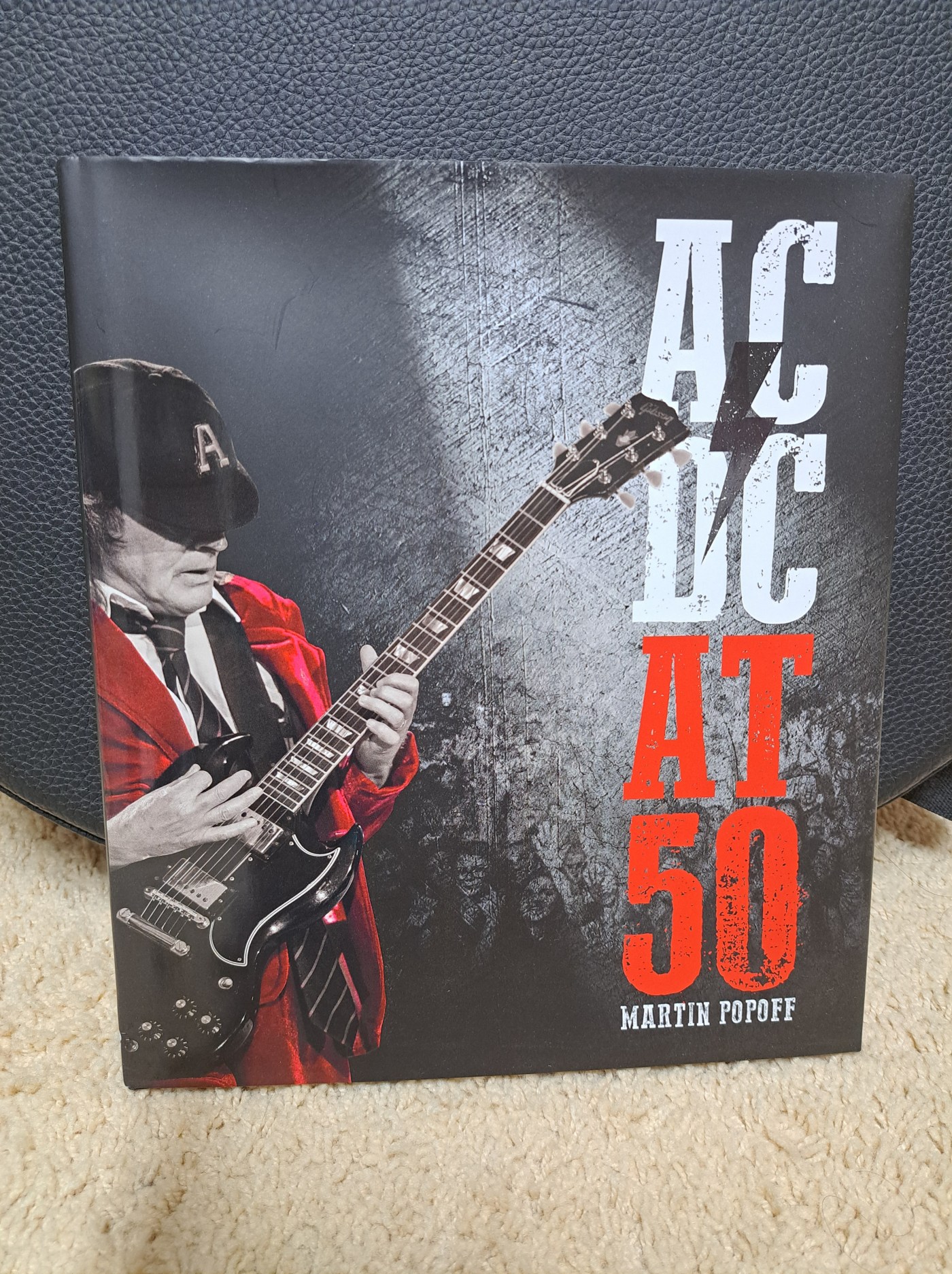
Haters can say all they want about AC/DC. Their music is boring. They’ve made the same album 17 times (or however many studio albums they have). They’re devil worshipers and all that nonsense. But, believe it or not, rock ‘n’ roll would not have been the same without AC/DC. Heck, pop culture wouldn’t have been the same without them.
Because AC/DC are one of my favorite bands and played a big role in my love for rock ‘n’ roll, I had to purchase Martin Popoff’s AC/DC at 50 (2023) when I found it at Barnes & Noble two months ago. Funnily enough, the book was $50.00. I already read Popoff’s AC/DC: Album by Album (2017) book and researched the band immensely in 2020, when I had nothing better to do during the pandemic, so I already knew stuff about the band. But, I didn’t care because that’s how much I love them and it’s not everyday I see Martin Popoff books out in the open, so I had to grab it before someone else did.

AC/DC at 50 details the band’s history and Popoff goes over 50 highlights (good and bad) throughout the band’s career. It’s basically an extended (and better documented) version of their VH1 Behind the Music episode. Popoff briefly talks about the Young brothers’ troubled life in Glasgow, Scotland and their move to Australia, in search of a better life. It still boggles me that Mal and Angus were the youngest of eight children because of their strong and tough demeanor. Popoff also discusses vocalist Bon Scott’s life before joining AC/DC, how he ended up playing the bagpipes on “It’s a Long Way to the Top (If You Wanna Rock ‘n’ Roll),” the story behind the Highway to Hell (1979) album cover, the troubled Flick of the Switch (1983) recording sessions, touring with The Rolling Stones, and much more.
Flick of the Switch is one of my favorite AC/DC albums, however, the recording sessions were an absolute mess. Apparently, there was more to the story than the Young brothers refusing to hire Mutt Lange as producer again. For starters, drummer Phil Rudd was being a very bad boy. Popoff notes he was smoking so much pot that he started to hallucinate, he got a girl pregnant in France, and even hooked up with one of Mal’s relatives. Considering that Poison fired Richie Kotzen for sleeping with drummer Rikki Rockett’s then-fiancée, I’m surprised Mal didn’t beat the crap out of Rudd then. Or maybe he did and Popoff never bothered to mention it in the book. Plus, Angus was annoyed with vocalist Brian Johnson because he couldn’t sing well, which is strange to think about, considering his vocals would become much worse in later years.
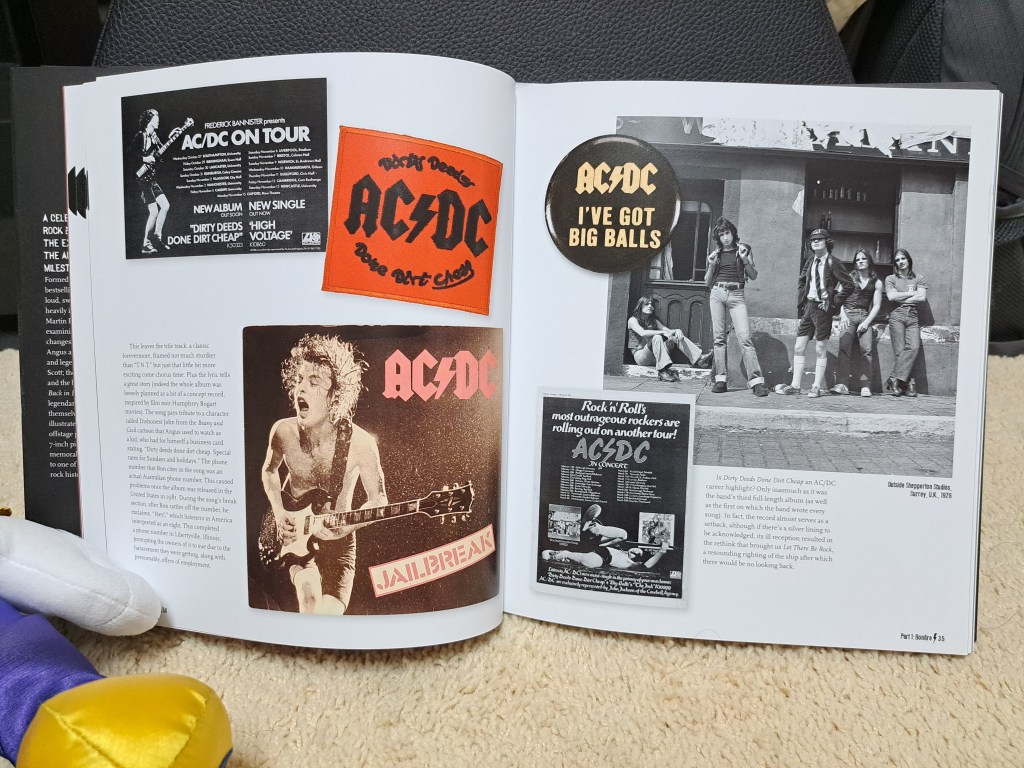

However, my favorite part was learning about the history behind the Powerage (1978), If You Want Blood You’ve Got It (1978), and the aforementioned Highway to Hell album covers. Powerage and Highway to Hell are my two favorite AC/DC album covers, with Let There Be Rock (1977) coming in third place. According to Popoff, all three covers were art-directed by Bob Defrin, photographed by Jim Houghton, with his trusted sidekick (business partner) Earl Steinbicker assisting. Besides the Highway to Hell album cover being from the Powerage photo shoots, Angus’ devil horns and tail were painted onto the picture; I thought the latter was a pitchfork. The biggest revelations for me, though, were finding out Angus’ guitar was broken in two for the If You Want Blood album cover and the “blood” was actually ketchup. For some reason, I actually thought the guitar went through his stomach.
As for the photos, they’re incredible, despite that horrific photo of Scott in The Valentines haunting me for the rest of my life. I’m sorry, Bon Scott with straight hair, no thank you! But, I enjoyed seeing photos from AC/DC’s career, especially the live shots, from beginning to end. My favorite photo is the group shot of numerous artists that performed at the Molson Canadian Rocks for Toronto (or simply, Toronto Rocks) benefit concert in 2003, to rejuvenate Toronto’s economy after the SARS disaster. Angus and guitarist Keith Richards look like they’re best buds, which I love! My only criticism about the photos is that some of the captions have the wrong dates, but it is what it is.

The caption says this photo is from Monsters of Rock, at Donington Park on August 22, 1981. The correct date is August 17, 1991.

The caption for this photo says it was taken in 1990, but it looks more like 1985-1986, during the Fly on the Wall era. Plus, bassist Cliff Williams’ hair was not that dark in 1990.

However, this photo of Johnson taking all of the band’s credit at the Rock & Roll Hall of Fame is hilarious!
When it comes to books, movies, and TV shows, I always skip to the end because I’m extremely impatient. Does the villain go to jail, do the lovers finally get together, does Jack survive the Titanic? Spoiler alert, he doesn’t. However, I tried to avoid the ending as best as I could for AC/DC at 50 because I knew the final outcome of the band’s history and it’s not a happy ending. Mal gets dementia and eventually dies from the illness, Rudd gets into legal trouble and is kicked out of the band, Williams retires from the music business; they release Power Up (2020), but can’t go on tour because of the pandemic, and all that stuff. It’s depressing, but it was not the author’s fault. I just don’t want to accept a world without Mal and it makes me upset that he never got to take his proper final bow because he deserved it. The whole band deserved better, even Chris Slade.

Overall, I loved the design of this book and it was well put-together. It’s a very concise book. There are four parts, 50 chapters, each chapter is 2-4 pages long, and there are 175 pages total (not including the discography section). Therefore, Popoff breezes through the band’s history at the speed of lightning. No dwelling on Mal and Angus’ childhood, no dwelling on Rudd’s legal issues; none of that. This book was easy to read, very straightforward, and honest. Like his previous AC/DC book, Popoff did not hold back any negativity towards his least favorite AC/DC albums. Oh and by the way, each chapter is named after a different AC/DC song, which was a nice touch. Good and bad things considered, I’ll give AC/DC at 50 a rating of 4.8 out of 5.0 stars.

If you enjoyed this post, feel free to like it and share it with your friends. I write about music, Disney, movies, shows, and mental status. If that sounds like your cup of tea, please subscribe to my blog for more content like this! To help me keep this blog going, you can either make a donation or support me through Patreon. You can also follow me on social media through Facebook, Instagram, and Twitter!
Don’t forget to leave a comment down below to start a conversation!
Take care and see ya real soon!
Lana

 Lana Teramae | Me, Myself and Time
Great stuff Lana. I got this one as well and its a great read. Martin always delivers the goods on these kinds of books. VH at 50 is another great one by Popoff as well.
LikeLiked by 1 person
Oh yes, I love Martin Popoff! He really knows his stuff when it comes to hard rock and heavy metal. Oh that’s right, he wrote a ‘Van Halen at 50’ book, I forgot about that. I know he did a ‘Rush: Album by Album’ book too and I’m considering buying that one because of my newfound interest in the band. Thanks for reading, Deke!
LikeLiked by 1 person
Phil Rudd lives in New Zealand and he’s still often in the news. He tried to arrange a murder at one point, I think….
LikeLiked by 1 person
He’s still in the news, really? About murder?
LikeLike