I wrote this review in February 2026, but with the 50th anniversary of Rocky (1976) being today, November 21st, I figured now would be a good time to post it after delaying it for so long.
Have I literally been living under a rock this entire time? I can’t believe it took me so long to get into the Rocky film franchise. That’s what happens when you watch too many Despicable Me and Alvin and the Chipmunks movies, people! Almost all of the Rocky films are simply amazing. I have my issues with Rocky II (1979) and Rocky V (1990), but I think the rest of the films are solid and worth watching. We are currently in the year 2026, which means Rocky Balboa (2006) turns 20 years old this year! It was released on December 20, 2006. Being the sequel to Rocky V, which received mixed-to-negative reviews upon release, the film takes place 16 years later, where Rocky Balboa (played by Sylvester Stallone) is now a widower, having lost his wife Adrian (played by Talia Shire) to cancer. Already retired from boxing, he gets the urge to fight again after seeing a computer simulated fight between a younger version of himself and current heavyweight champion Mason “The Line” Dixon.
The movie features a mixture of familiar faces and new faces. Besides Stallone, Burt Young returns as Paulie Pennino, Balboa’s brother-in-law and best friend; and Tony Burton returns as Tony “Duke” Evers, Balboa’s trainer who previously trained Apollo Creed, Balboa’s former rival. Robert Balboa Jr., Balboa’s son, and Marie, a girl Rocky walked home in the first Rocky film, also make appearances but they’re played by different actors, Milo Ventimiglia and Geraldine Hughes respectively. Sage Stallone, Stallone’s real-life late son who played Robert in Rocky V, couldn’t return for Rocky Balboa because he was working on another project at the time. It’s also worth mentioning that Pedro Lovell reprises his role as Spider Rico, Balboa’s opponent from the opening scene of the first Rocky film. Mason “The Line” Dixon is played by real-life former professional boxer Antonio Tarver.
What’s cool about Rocky Balboa is that there are multiple references to Rocky (1976). Everything from the doo-wop a cappella music in the opening scene to Balboa drinking egg yolk for breakfast, Rocky fanatics have enough references to fangirl over and it’s awesome! Whether it was for nostalgia purposes or to give newcomers their own version of the first Rocky film, I don’t know. But after the underwhelming ending of Rocky V, I think Stallone made the right call to pursue a similar direction as the first film to remind diehard fans why they fell in love with Balboa’s character in the first place and give younger viewers someone to root for. Rocky Balboa was basically the Rocky film for younger generations. Stylistically, both films are very different, but Rocky and Rocky Balboa have more in common than Rocky and Rocky II do.
Out of all the references to the first Rocky film, my favorite is the inclusion of little Marie because I think it’s a good full circle moment for both her and Balboa. In the first film, Marie is a loudmouth who hangs out with the wrong crowd and smokes too many cigarettes. Balboa warns her to turn her life around or else she’ll end up on the streets, and in return, she tells him, “screw you, creepo.” She also appears in a deleted scene from Rocky V, where she ends up homeless and again tells Rocky, “screw you.” Bringing Marie back for Rocky Balboa allows viewers to see how far she’s come since her childish ways and that she eventually did take Balboa’s advice to become a better person. Despite Marie being incredibly rude to him in the first Rocky film, Balboa felt the need to protect and look after her by giving her a job as a hostess at his restaurant and befriending her son Steps (played by James Francis Kelly III). He even defends her when a mean girl and her friends call Marie “a pig.”
She and Balboa develop a close friendship that is beautiful to watch unfold. In fact, Marie is the one who convinces Balboa to take on the fight with Dixon. She becomes somewhat of an Adrian-type figure for him when he needs it most. I am a bit bummed that the original actress who played Marie in the first film, Jodi Letizia, didn’t return for Rocky Balboa because though Hughes does a great job in the film, she doesn’t look like Letizia. As a result, part of me still sees Marie as a homeless woman on the streets of Philadelphia. I also have to point out a scene between Marie and Balboa that doesn’t sit well with me, where Marie tells Balboa that Steps’ father is from Jamaica, Balboa then asks if they met on a cruise ship, and Marie seemingly offended responds with “not really.” I know Balboa didn’t mean it in a rude way, but I still found his response impolite.
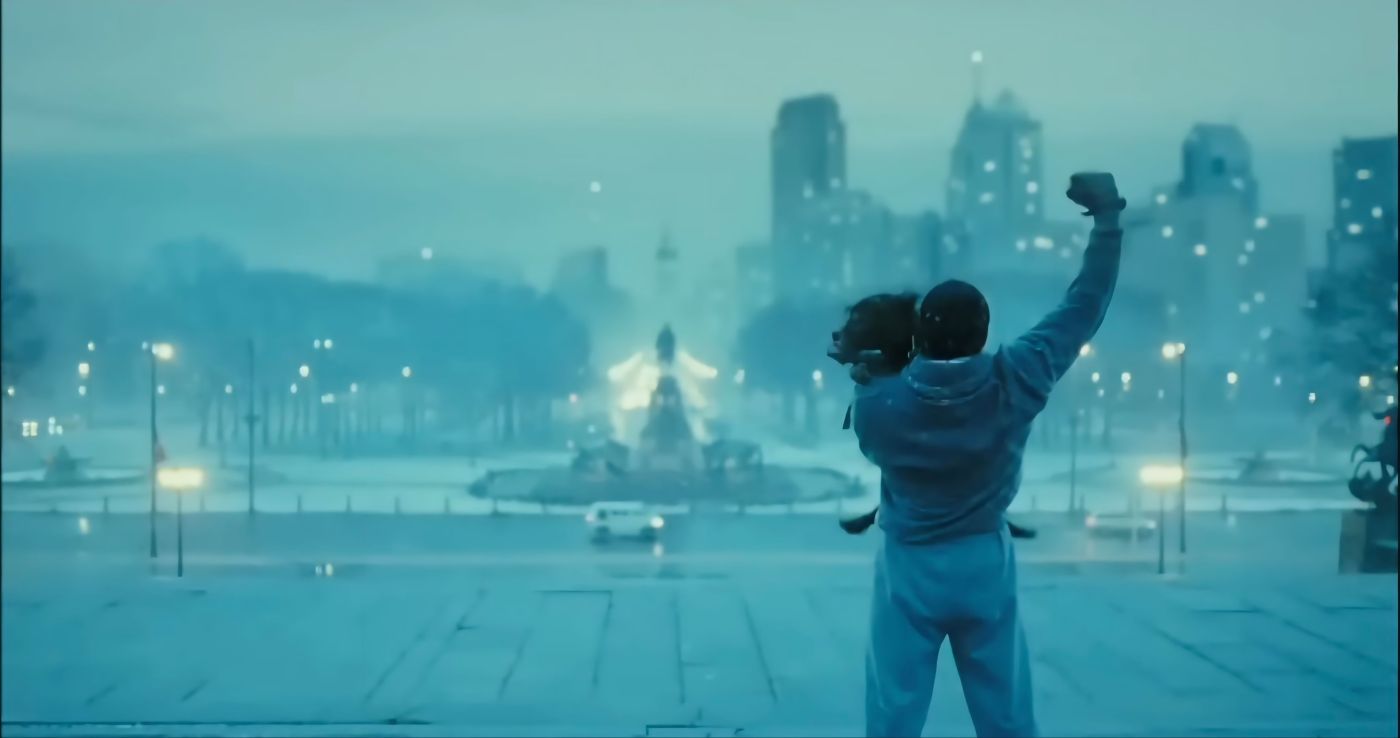
One of my favorite scenes in the film is when Balboa and Steps go to an animal shelter, where Balboa adopts an older dog named Punchy; Steps jokingly came up with the name. Steps keeps pushing for a younger dog with more energy, but Balboa insists on going with the older dog, believing there’s still a lot of life left in him. In a way, Punchy reflects Balboa’s current situation, where both are getting up there in age, but they still have something worth fighting for. Steps didn’t believe in Punchy because he was an older dog while critics didn’t believe that Balboa stood a chance against Dixon because Balboa was way past his prime. In the film, Balboa is approaching his 60s and deemed a “Balboasaurus” when news of him fighting Dixon gets out. Punchy could’ve ended up euthanized at the animal shelter if Balboa didn’t take a chance on him. Balboa and Punchy encourage each other to better themselves mentally and physically, which is why the scene of them running up the classic Rocky steps outside the Philadelphia Museum of Art is such a beautiful and motivational scene; a modern twist of the classic scene from the first film.
Next, we gotta talk about Robert! His character changed so much since Rocky V, yet he’s still the same; if that makes sense? In Rocky V, Robert is struggling to adjust to his new life in Philadelphia and needs his father to show him the ropes. Though they patch things up at the end of the movie, Robert and his father eventually grow apart, going so far as to blame his father for his failures and being stuck in his father’s shadow. Like how Robert loses his way and gets involved with the wrong crowd in Rocky V, the same thing happens in Rocky Balboa, where Robert doesn’t believe in himself anymore and gets involved with the wrong crowd again (or wrong job, so to speak). Robert needed his father to push him down the right path and encourage him not to let others’ opinions of him dictate who he is. Balboa’s “It ain’t about how hard you hit…” speech is my favorite speech in the entire franchise because it sums up what Balboa’s character is all about. It’s motivating and inspiring for people who are going through similar obstacles in their life.
While watching Rocky Balboa the first couple of times, I noticed that Dixon’s character faces similar challenges as Balboa from Rocky III (1982). To protect Balboa, Mickey Goldmill, Balboa’s beloved manager and trainer, makes him do easier fights with handpicked opponents. As a result, Balboa gets sucked into the glamorous life of a heavyweight champion and loses that spark he once had as a true fighter. The same can be said for Dixon, who never fought anyone who could challenge him to go the distance. Not surprisingly, Dixon gets sucked into the glamorous life of being a heavyweight champion and gains a big ego, which does not help his image at all. Balboa is the one who pushes Dixon to go the distance and prove to the world that he really is a good fighter.
Obviously, we can’t talk about Rocky Balboa without mentioning Balboa’s cavum septi pellucidi diagnosis from Rocky V miraculously going away by the time we get to Rocky Balboa. Stallone stated that all athletes have some form of brain damage, but Rocky V made it seem like Balboa’s health was in danger if he took up fighting again. That’s why his hands were uncontrollably shaking at the beginning of Rocky V, right after winning his fight against Ivan Drago. I mean that man was a machine who was strong enough to kill Apollo, so I’m not surprised Balboa suffered a lot of damage caused by Drago’s punches. Even though Balboa never bothered to get a second opinion on his diagnosis, if his injuries weren’t that serious, he would’ve continued fighting without hesitation. It just doesn’t make sense for Balboa to be physically capable and healthy enough to get his boxing license renewed after the setbacks he experienced in Rocky V. Then again, Balboa showed no hesitation to fight Tommy Gunn on the streets after his diagnosis, so what do I know?!?!?
Not going to lie, I know the purpose of Rocky and Rocky Balboa is to show that winning doesn’t matter. However, part of me feels like the endings for both films are unsatisfying. But realistically, it wouldn’t have made sense for Balboa to win either of those fights because in the first film, he was at the beginning of his boxing career and needed time to develop. In the last film, Balboa hadn’t fought anyone in 16 years and was still dusting off his chops. Again, the whole point of both films is to show you don’t have to win to go the distance. As long as you push yourself to do your best, that’s what matters most. While both Rocky and Rocky Balboa are very similar, I love the modern flair of the latter and seeing Balboa experience new personal challenges in his later years. I will give Rocky Balboa a rating of 5 out of 5 stars.
If you enjoyed this post, feel free to like it and share it with your friends. I write about music, Disney, movies, shows, and mental status. If that sounds like your cup of tea, please subscribe to my blog for more content like this! To help me keep this blog going, you can either make a donation or support me through Patreon. You can also follow me on social media through Facebook, Instagram, and X!
Comment below your thoughts on the Rocky Balboa movie!
Take care and see ya real soon!
Lana


Leave a Reply