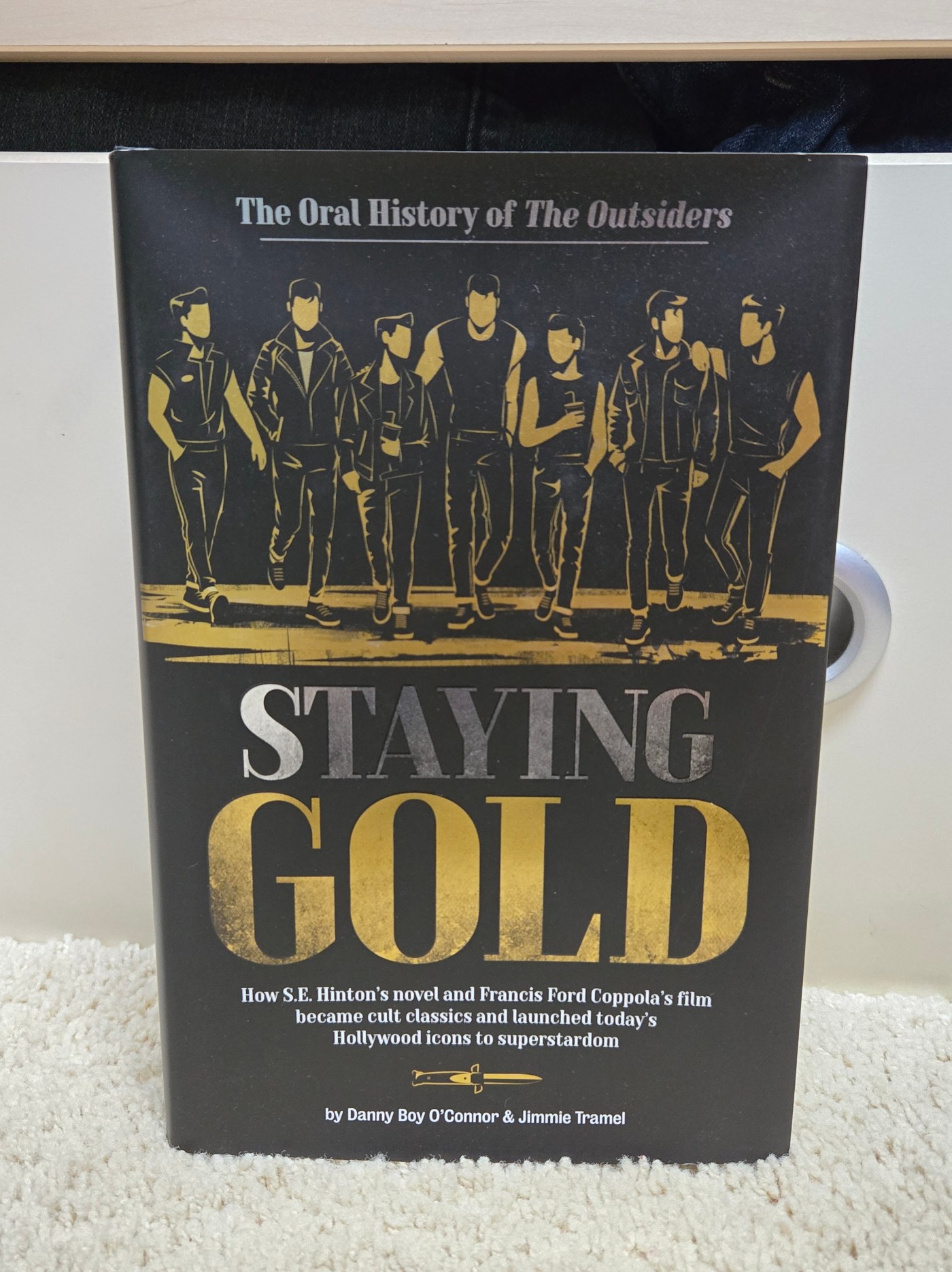
The Outsiders (1983), specifically “The Complete Novel” version, is one of my favorite movies of all time. Therefore, when I saw that Barnes & Noble at Ala Moana had a book called, Staying Gold: The Oral History of The Outsiders (2025) by Danny Boy O’Connor and Jimmie Tramel available for purchase, I bought it immediately! The book talks about the legacy of The Outsiders, dating back to when author S.E. Hinton wrote The Outsiders in the mid ‘60s. Staying Gold goes into ginormous details about the 1983 movie, which launched the careers of actors you may have heard of such as Tom Cruise, Emilio Estevez, Ralph Macchio, Matt Dillon, Rob Lowe, Patrick Swayze, and C. Thomas Howell. The book also lightly covers The Outsiders TV show that only lasted for one season in the early ‘90s, The Outsiders House Museum (located in the Curtis brothers’ house shown in the film), and The Outsiders musical. There are nice photographs in the book, as well, but they’re all in black and white, and the captions are hard to read for old people like me.
I was shocked to find out that Hinton wrote The Outsiders when she was 16! More specifically, she started The Outsiders when she was 15, as a short story about a boy who was beaten up on his way home from the movies; sound familiar? While attending Will Rogers High School in Tulsa, Oklahoma, Hinton experienced firsthand what it was like to be caught between two rival gangs, the Greasers and the Socs. People were judged by where they came from and how much money they had. If you were poor and from the north side of town, you were a Greaser; if you were rich and from the south side of town, you were a Soc. Being neither a Greaser nor a Soc, Hinton was able to sympathize with both sides of the party.
While the Socs had all the money in the world, they had a certain image to keep up with, making them internalize their feelings, in fear of being judged by others. The Greasers were constantly judged for their social backgrounds and considered “outsiders” that people should avoid like the plague. This reminds me of a scene from The Outsiders film where Ponyboy Curtis (played by Howell) and Jerry (played by Gailard Sartain) are riding an ambulance to the hospital, following the church burning down. Moved by his and his friends’ bravery in rescuing the children from burning to death, Jerry asks Ponyboy if they are “professional heroes or something.” To which, Ponyboy quickly responds with, “We’re Greasers,” horrifying and surprising Jerry. It’s like Jerry believed Greasers didn’t have the heart to do such a good deed!
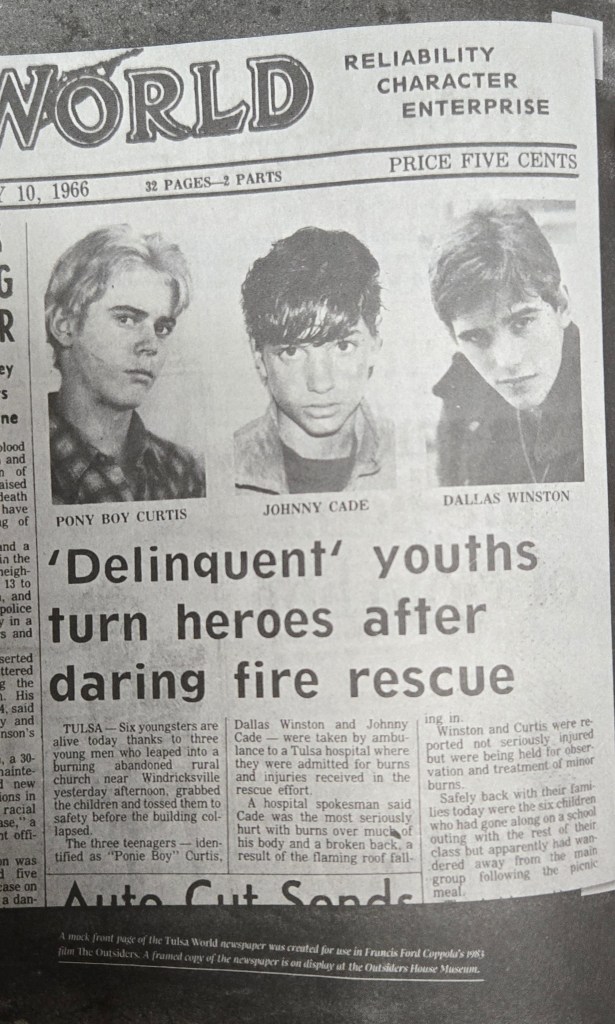
This is a mock newspaper front page used in director Francis Ford Coppola’s The Outsiders. The story is about Ponyboy, Johnny Cade (played by Macchio), and Dallas Winston (played by Dillon) risking their lives to save endangered children from a church fire.
While Hinton wrote The Outsiders from a Greaser’s perspective, she also highlighted the Socs’ struggles and pressures they faced growing up, making the book resonate with many people around the world, not just young adults. The realism portrayed in the book, inspired a school librarian from Lone Star Elementary School, Jo Ellen Misakian, to send a letter to Coppola, asking him to consider turning The Outsiders into a movie. Along with the letter was a petition signed by more than 100 students from Lone Star Elementary School. Staying Gold talks about the conversations that took place leading up to the finalized screenplay for the film, the unique casting process for the film, Coppola’s insanely brilliant way of setting up the rivalry for the Greasers and Socs for the film, and the extras and stunt coordinators involved for the film. I’ve watched the documentaries on my DVD for The Outsiders: The Complete Novel, so I knew about the casting process and how Coppola separated the rival gangs by making them play football against each other, etc. I also knew about Cruise throwing up before doing a backflip on a parked car for a scene right before the rumble. Luckily, there were stories that I wasn’t familiar with, like casting the extras, the amount of costumes involved, and the filming locations (all shot in Tulsa, by the way).
What I enjoyed most about Staying Gold were the stories about regular people who were hungry, had a dream to get into the film/television business, and made it happen. Trey Callaway, who was a Soc extra in the film, always loved movies and TV, but didn’t think it was possible for a Tulsa kid like him to pursue a career in the film business. When he became an extra for The Outsiders, not only did he learn about the moviemaking process firsthand, he also learned that to be part of the action, he has to join the action by following wherever it goes. He then went to study at the USC School of Cinematic Arts, and became a screenwriter and producer. Jill Simpson was a senior at the University of Oklahoma studying film when Coppola was filming The Outsiders. Her professor encouraged her class to visit the set and observe everything that goes on behind the scenes, so she would observe on the weekends and did the same thing when Coppola was filming Rumble Fish (1983). One fateful day, Simpson, who already graduated with a degree in film production, asked Coppola if she could watch and observe what he does, which he said yes to. As a result, she gained a lot of connections and experience, which includes casting and coordinating scenes for Rumble Fish, thanks to taking a chance on her dream.
Besides the black and white photos with the small captions, my only other complaint about Staying Gold is that it talks too much about the 1983 movie and the events that took place while making it. For example, the book talks about fangirls staying at the Tulsa Excelsior Hotel, where the cast was staying, in hopes of meeting Dillon. Don’t get me wrong, I love the movie, but it would’ve been nice to learn more about The Outsiders TV show and The Outsiders musical because technically, they’re part of The Outsiders legacy. When I purchased Staying Gold, I thought it was going to be like The Exorcist Legacy: 50 Years of Fear (2025) book by Nat Segaloff, which besides the 1973 movie, also talks in great detail about the infamous sequels and The Exorcist TV show that was canceled after two seasons.
Instead, Staying Gold is mostly centered on The Outsiders movie, with one tiny chapter about the TV show, which I was bummed about because I wanted to know more about how the cast was selected and why the show wasn’t filmed in Tulsa, Oklahoma; etc. The 1983 movie’s audition process and filmmaking process are well documented, but how often do you hear people talking about The Outsiders TV show? It wasn’t a successful part of The Outsiders legacy and there are fans who wish the show never existed. Nonetheless, it’s still part of The Outsiders legacy and it should’ve received a bigger section than what we got in Staying Gold. Same thing with The Outsiders musical; there’s only one chapter talking about the musical and it doesn’t even talk about how the cast was selected. Keep in mind, The Outsiders musical has been a thing since 2023 and according to Wikipedia, it’s been a revolving door of cast members.
Though I was disappointed about the lack of information regarding The Outsiders TV show and The Outsiders musical, Staying Gold accomplished what it set out to do, which was to prove why The Outsiders has stood the test of time. Yes, a lot has changed since the ‘60s with social media, streaming services, and AI, but feeling like an “outsider” looking for a place to belong is still something everyone can relate to. One of my favorite parts of the 1983 movie is when Ponyboy recites Robert Frost’s “Nothing Gold Can Stay” poem, which is later referenced when Cade tells Ponyboy to, “stay gold,” right before he dies. In the movie and book, Cade tells Ponyboy, through his letter, that being gold is not losing your innocence. Fans of the book came up with their own interpretations of what it means to “stay gold,” centered around a similar idea. To Scott Caan, an actor and filmmaker, staying gold means keeping it real and being pure for as long as you can.
My favorite interpretation came from Danya Taymor, director of The Outsiders musical:
“‘Stay gold’ is such a bittersweet idea. I think ‘Stay gold,’ to me, means holding on to hope and goodness and possibility, even–and especially–when things are at their darkest and most challenging. It’s about belief as well, holding on to the belief and the knowledge that there is goodness in the world. One of my favorite texts in the book is the letter Johnny writes to Ponyboy. He says ‘There is still a lot of time to make yourself who you want to be. There is still so much good in the world. Tell Dally. I don’t think he knows.’ Why does Ponyboy survive and Dally can’t? It’s because he has to stay gold and Dally couldn’t be reached in time. It could save somebody’s life, that idea or concept,” said Taymor.
In closing, Staying Gold: The Oral History of The Outsiders is not a perfect book, but for fans of the 1983 movie and The Outsiders book, it gets the job done. Despite the negatives, I would read this book again because as mentioned earlier, The Outsiders is one of my favorite movies and I find the book interesting enough to enjoy. I’ll give Staying Gold: The Oral History of The Outsiders a rating of 3.5 out 5 stars.
If you enjoyed this post, feel free to like it and share it with your friends. I write about music, Disney, movies, shows, and mental status. If that sounds like your cup of tea, please subscribe to my blog for more content like this! To help me keep this blog going, you can either make a donation or support me through Patreon. You can also follow me on social media through Facebook, Instagram, and Twitter!
Don’t forget to leave a comment down below to start a conversation!
Take care and see ya real soon!
Lana

 Lana Teramae | Me, Myself and Time
Leave a comment